A torn rotator cuff is not automatically a surgical problem: the scan, symptoms, weakness, tear pattern, and daily demands all matter. By the end, you will understand how doctors confirm the diagnosis, when non-surgical care is reasonable, what repair involves, and what recovery can realistically require.
Key takeaways
- Supraspinatus tears are common; teres minor tears are uncommon.
- Doctors combine shoulder examination with imaging to confirm a rotator cuff tear.
- Non-surgical care can suit selected tears and manageable symptoms.
- Recovery depends on tear size, tendon quality, repair, and rehabilitation.
Which rotator cuff tendon is torn, and how serious is the injury?
A rotator cuff tear means that one or more tendons linking the shoulder muscles to the upper-arm bone is frayed or split. The cuff includes the supraspinatus, infraspinatus, teres minor, and subscapularis tendons. A teres minor tendon tear is uncommon; supraspinatus tears are more frequent.
| Type of tear | What it means | What it suggests |
|---|---|---|
| Partial-thickness | The tendon is damaged but not torn through its full depth | Pain and weakness can occur, while some tendon attachment remains |
| Full-thickness | The tear extends from the tendon’s upper surface to its lower surface | Greater weakness and difficulty raising the arm are more likely |
| Retracted | The torn tendon has pulled away from its normal attachment | A larger gap can reduce function and make repair more difficult |
| Acute traumatic | A sudden injury, such as a fall or forceful lift, causes the tear | Sudden pain followed by new weakness needs prompt assessment |
| Degenerative | Tendon wear develops gradually with age or repeated use | Symptoms can build slowly and do not always require surgery |
Pain when lifting your arm, night pain when lying on that shoulder, clicking, and reduced reach suggest the cuff is affecting function. The strongest warning sign is weakness: you cannot raise the arm, keep it elevated, or rotate it as before.
An MRI tear alone does not prove it causes your pain, because cuff abnormalities become more common with age; examination findings and the change in your ability matter too.
How doctors confirm a rotator cuff tear
A diagnosis depends on a match between your symptoms, examination findings, and imaging—not on a scan alone. Pain when lifting the arm, night pain, or weakness after an injury raises suspicion, but pain can also come from arthritis, a stiff shoulder, neck nerve irritation, or inflammation.
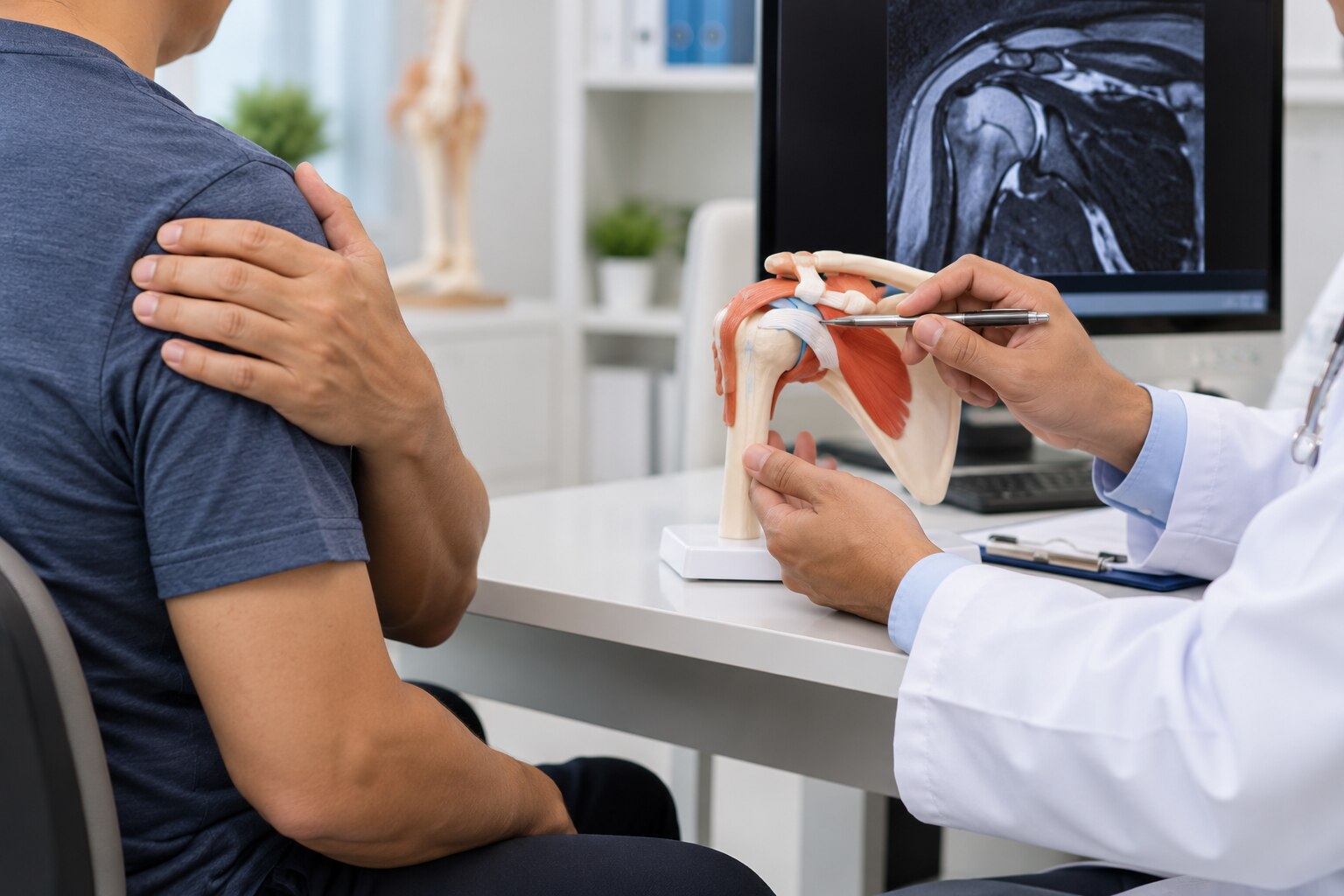
During shoulder strength testing, the doctor compares both sides and checks whether weakness persists when pain is reduced. A true loss of strength, a dropping arm, or inability to hold the arm in position supports a functionally important tear. Range-of-motion testing compares active movement, which you perform yourself, with passive movement, which the examiner guides.
Markedly reduced active motion with better passive motion suggests tendon failure; both movements being restricted points more toward stiffness or arthritis. Belly-press and lift-off manoeuvres help detect a subscapularis tear.
Imaging answers different questions:
- Shoulder X-ray shows fracture, arthritis, bone spurs, or a high-riding upper-arm bone; it does not show the tendon directly.
- Ultrasound can show a moving tendon, a partial or full-thickness defect, and sometimes retraction.
- MRI maps tear size, tendon retraction, muscle wasting, and fatty change, which affect repair decisions.
An abnormal MRI does not prove that the tear causes your pain. Cuff changes are common with age, so doctors weigh the scan against weakness, loss of function, trauma, and competing diagnoses.
When non-surgical care is reasonable—and when repair is considered
For a degenerative, non-traumatic tear, start with activity changes that reduce painful overhead lifting, suitable pain relief, and a structured rotator cuff physiotherapy programme. Physiotherapy can improve strength and function even when a full-thickness tear remains visible; feeling better does not prove that the tendon has healed.
A corticosteroid injection can reduce pain for a short period and help you participate in rehabilitation, but it does not mend the tendon. Repeated injections can harm tendon biology, and an injection close to planned surgery may increase infection or revision risk.
Platelet-rich plasma is not an established substitute for exercise therapy or repair, so discuss its uncertain benefits before paying for it.
Repair deserves prompt consideration when:
- A previously useful shoulder develops an acute traumatic tear with marked weakness or sudden loss of active movement.
- Pain or loss of function continues after an adequate rehabilitation trial.
- Weakness prevents work, sport, or essential daily tasks despite non-surgical care.
- Imaging shows a large or retracted tear, particularly before muscle atrophy and fatty degeneration make reattachment harder.
The choice is not simply “surgery versus no treatment.” Small-to-medium tears can improve substantially with physiotherapy, while repair offers better average long-term function but carries surgical risks. Dr. Santosh Pandey can help weigh tear size, weakness, work demands, smoking, diabetes, and injection timing before choosing a plan.
Related services
Rehabilitation Services ## Rehabilitation Services Rehabilitation Services play a vital role in helping individuals recover from injuries, surgeries, illnesses, and physical... View service → |
Arthroscopy Procedures by Dr. Santosh Pandey – Orthopedic Surgeon Dr. Santosh Pandey is an experienced orthopedic surgeon providing advanced arthroscopy procedures for the... View service → |
What happens during arthroscopic rotator cuff repair
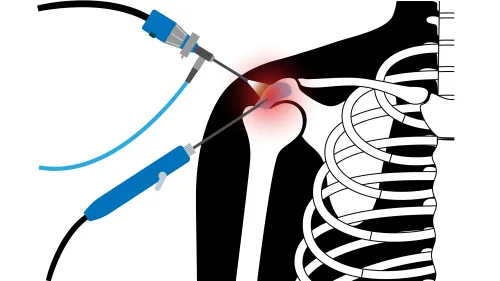
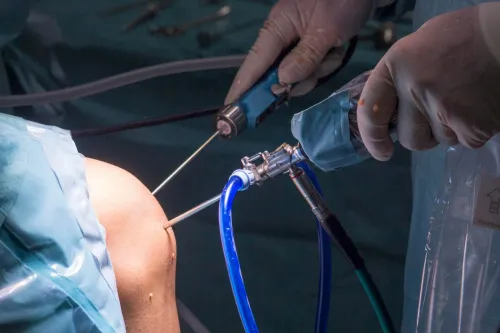
A surgeon performs an arthroscopic rotator cuff repair through small portal incisions around the shoulder. A camera identifies the tear, and instruments clear damaged tissue and prepare the attachment area on the humeral head without removing healthy tendon.
The surgeon then places suture anchors into the humeral head. Strong sutures passed through the torn tendon pull its edge back to its original footprint, where knots or a knotless system hold it against bone while the tendon-to-bone attachment heals.
Additional procedures, such as removing an inflamed bursa or treating a biceps problem, depend on the findings.
Repair does not restore strength immediately. The tendon needs protection, followed by a staged rehabilitation plan that limits excessive stiffness without stressing the fixation. Larger tears, poor tissue quality, diabetes, smoking, tendon retraction, muscle atrophy, and fatty infiltration reduce the chance of structural healing. Stop nicotine before surgery and throughout recovery.
| Choice | Potential benefit | Main trade-off |
|---|---|---|
| Repair surgery | Reattaches a repairable tendon and may improve strength and function | Anaesthesia, infection, stiffness, nerve injury, blood clots, recurrent tearing, and prolonged rehabilitation |
| Continued non-surgical care | Avoids surgical risks and can reduce pain through exercise and activity changes | Does not reattach a detached tendon; weakness or loss of function can persist |
Discuss any corticosteroid injection near the planned operation, because timing and repeated use can affect infection, revision risk, and tendon biology. A recurrent defect on later MRI does not automatically mean failure if pain and function have improved.
How long recovery takes and what affects the result
Expect rotator cuff repair recovery to take months, not weeks. A shoulder sling is commonly worn for 4–6 weeks, while early movement remains passive or assisted to protect the tendon-to-bone attachment. Active motion follows, then strengthening; meaningful improvement can continue for 6–12 months.
An early inability to lift your arm does not by itself prove that the repair has failed.
| Activity | Usual progression | What affects timing |
|---|---|---|
| Work | Desk duties may resume before physical work; lifting, pushing, and overhead tasks wait longer | Pain, strength, dominant arm, and job demands |
| Sport | Walking and lower-body exercise come first; throwing, swimming, and contact sport require gradual strengthening | Tendon healing, range of motion, and sport-specific control |
| Driving | Wait until sling use has ended and you can control the vehicle safely | Reaction time, pain medication, and shoulder movement |
Healing and recurrent tearing depend heavily on the original injury and your health. Larger or retracted tears, muscle atrophy, fatty infiltration, older age, smoking, diabetes, and poor tendon quality reduce structural healing. Stop nicotine before surgery and throughout healing; simply reporting that you smoke after surgery does not remove its effect.
- Follow sling, exercise, lifting, and physiotherapy instructions; overloading the repair early can cause failure.
- Report fever, wound drainage, increasing redness, new numbness, calf swelling, or breathlessness promptly.
- Postoperative stiffness, infection, nerve injury, blood clots, anaesthetic problems, and recurrent tearing are recognised risks.
A recurrent defect on MRI does not always mean treatment failure if pain and function have improved. Reverse shoulder replacement is reserved for selected irreparable tears with severe loss of elevation or cuff-tear arthritis, not a routine substitute for a repairable tendon.
Frequently asked questions
Which rotator cuff tendon is torn, and how serious is the injury?
The tear may involve the supraspinatus, infraspinatus, teres minor, or subscapularis tendon. Doctors assess its size, depth, retraction, muscle quality, symptoms, and effect on shoulder function.
How do doctors confirm a rotator cuff tear?
Doctors use your symptoms and shoulder examination, then select imaging such as an X-ray, ultrasound, or MRI to identify the torn tendon and assess the injury.
When is non-surgical care reasonable for a rotator cuff tear?
Non-surgical care is reasonable when pain and weakness are manageable, the tear is suitable for observation, or symptoms improve with activity changes, medicines, physiotherapy, and time.
When is rotator cuff repair considered?
Repair is considered when pain or weakness persists despite appropriate non-surgical care, when a traumatic tear causes substantial loss of function, or when the tear has features that favour surgery.
What happens during arthroscopic rotator cuff repair?
Through small incisions, the surgeon inspects the shoulder, prepares the tendon and bone, and secures the torn tendon to the upper-arm bone with anchors and sutures when repair is appropriate.