A robotic system does not replace the orthopaedic surgeon or decide whether you need a knee replacement. It combines imaging or surgical measurements with navigation, planning software, and controlled instrument guidance to help the surgeon execute a selected implant plan; by the end, you will know what that adds, where it falls short, and which questions matter for your own operation.
Key takeaways
- The surgeon controls every decision; the robot guides planning and bone-cutting tools.
- Robotic systems can improve implant positioning and ligament-balancing measurements.
- Suitability depends on knee damage, symptoms, health, and the surgeon’s assessment.
- Ask how robotic assistance changes your plan, recovery, risks, and total cost.
What a robotic knee replacement system actually does
A robotic knee replacement does not operate independently. In robotic-assisted knee surgery, the orthopaedic surgeon selects the implant, plans the bone cuts, controls the cutting instruments, checks ligament tension and stability, and makes every final decision.
Two main approaches create the knee’s working model:
| Approach | How the model is built | What it adds |
|---|---|---|
| Image-based | A preoperative CT scan creates a three-dimensional model of the knee | A separate digital planning step before surgery |
| Imageless | Measurements taken during surgery build the anatomical model | No preoperative CT scan for the robotic plan |
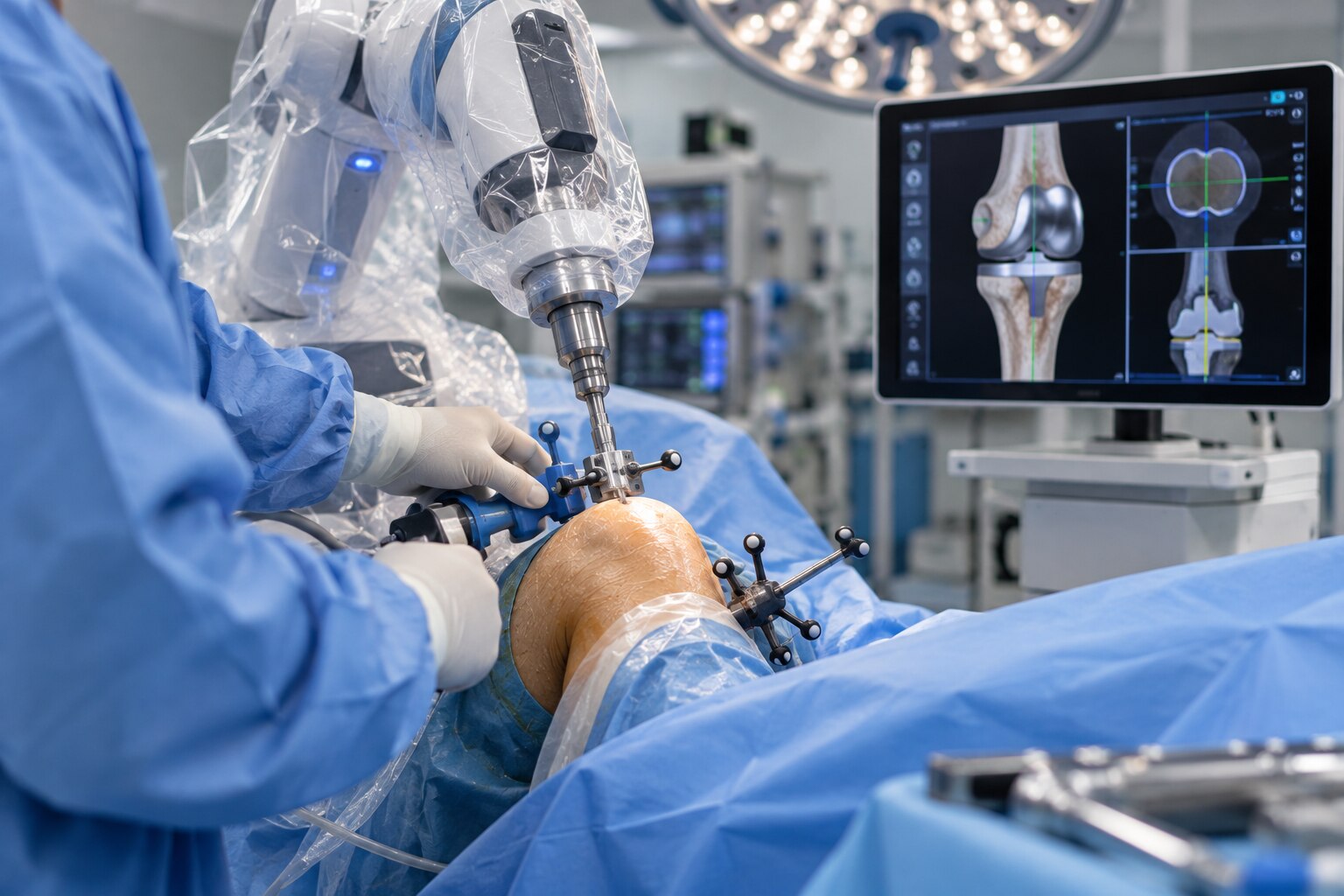
The three-dimensional planning software maps:
- Bone anatomy and deformity
- Proposed bone resections
- Implant size and position
- Limb alignment and implant rotation
- Flexion and extension joint gaps
- The expected effect of changing these settings
The surgeon can adjust this plan before making a cut. The system then helps translate the chosen plan to the patient’s knee, but it does not replace assessment of soft-tissue balance.
Depending on the system, a robotic arm positions the cutting tool or constrains it within planned boundaries. Tracking arrays fixed to the bone, along with cameras or other sensors, confirm the position of the bone and instruments throughout the procedure.
The robot supplies planning, navigation, and guidance. It does not independently perform the operation.
Where robotic assistance can make knee surgery more precise
Precision means measuring and adjusting each surgical variable rather than relying on visual judgement alone: planned bone resection thickness, limb alignment, implant rotation, joint-line position, flexion and extension gaps, collateral-ligament balance, and kneecap tracking. The system can show how changing a cut or implant position could alter alignment and gaps before bone cuts are made.
| Approach | How it works | Main limitation |
|---|---|---|
| Conventional instruments | Uses cutting guides, bone landmarks, and the surgeon’s measurements to set bone cuts and implant positioning | Landmark distortion or measurement error can produce alignment variation |
| Computer-navigated replacement | Tracks the knee anatomy and instruments with sensors or cameras during surgery | Navigation may show the saw’s position without controlling the saw itself |
| Robotic-assisted replacement | Adds a three-dimensional plan and, in some systems, haptic boundaries or robotic arm guidance that helps keep the tool within planned limits | Accurate execution still depends on registration and surgical decisions |
The strongest established benefit is closer execution of planned bone cuts and fewer X-ray alignment outliers than conventional instrumentation. That is a measurement advantage, not proof of less pain, better walking, fewer complications, or a longer-lasting implant.
Robotic guidance does not replace soft-tissue balancing. The surgeon still interprets ligament tension, collateral stability, flexion-extension gaps, and kneecap tracking, then adjusts implant positioning or resections when the plan does not produce a stable knee. Registration must also accurately match the patient’s anatomy; an error there can make a precise-looking plan wrong.
Which patients are suitable for a robotic knee replacement
Suitability begins with the medical indication for replacement, not the choice of instruments. Confirmed knee osteoarthritis severity, disabling pain, failed non-surgical care, and loss of function come first. Then assess which compartments are damaged, knee deformity, ligament stability, bone quality, body habitus, previous operations, and the proposed implant.
| Clinical pattern | Effect on robotic planning | Likely implication |
|---|---|---|
| One damaged compartment with intact ligaments | Supports bone-preserving planning | Unicompartmental knee replacement may be considered |
| Several damaged compartments | Robotic accuracy cannot limit disease to one area | Total replacement or another treatment may fit better |
| Substantial knee deformity | Customized planning may help, but landmarks and registration become harder | Proceed only if reliable correction and tracking are achievable |
| Previous hardware or altered anatomy | Metal and missing landmarks can obstruct imaging or registration | Extra planning, hardware removal, or conventional instruments may be needed |
| Poor bone quality or unstable ligaments | Accurate cuts cannot compensate for weak fixation or inadequate balance | A different implant or operation may be safer |
Robotic assistance adds little or is the wrong fit when you need an operation other than knee replacement, available imaging cannot produce a dependable plan, or the plan gains no meaningful benefit from robotic guidance. Do not proceed if heart, lung, infection, or other medical problems make anaesthesia or surgery unsafe.
Disease in multiple compartments or ligament insufficiency can still require total replacement or nonoperative care. Unusual anatomy can make customized planning valuable, but technical capability does not create eligibility for partial replacement. The surgeon must decide whether the replacement itself is appropriate before choosing robotic or conventional instruments.
What happens before, during, and after the procedure
The pathway starts with a clinical examination, standing knee X-rays, assessment of deformity and ligament stability, and discussion of the implant plan.
1. Before admission, your surgeon decides whether ordinary radiographs provide enough information. Image-based systems add a CT scan for CT-based planning: the scan creates a three-dimensional model, followed by a separate software-planning step. CT adds low but real ionising-radiation exposure and extra preparation; imageless systems build the model from measurements taken during surgery.
2. An anaesthesia assessment identifies medical problems that need optimisation, such as uncontrolled diabetes, anaemia, heart disease, or medication-related bleeding risk. You then complete admission and registration. During surgery, the team registers bone landmarks, attaches tracking arrays, and inserts tracking pins when required. The system verifies anatomy, alignment, and instrument position before any bone cuts.
3. Robotic assistance is not guaranteed from start to finish. Registration errors, unreliable tracking, unavailable equipment, or an unachievable plan can make the surgeon abandon the robotic workflow and use conventional instruments. Tracking pins add uncommon risks, including pin-site infection, loosening, fracture, or injury to a nearby structure.
4. After surgery, wound care and physiotherapy begin, followed by a graded progression from assisted walking to a walking aid and then independent walking. Attend scheduled follow-up appointments and report increasing redness or drainage, fever, calf swelling or breathlessness, worsening stiffness, or persistent pain.
How to weigh precision against the limits of the evidence
An accurate X-ray is not the same as a better knee. Randomized trials and systematic reviews in total knee replacement generally find improved radiographic alignment with robotic assistance, but no consistent short- or medium-term advantage in pain, patient-reported function, complications, or revision rates.
| Question | What the evidence supports | What it does not prove |
|---|---|---|
| Alignment | More precise bone cuts and fewer alignment outliers | Less pain or better walking |
| Early outcomes | Similar recovery and complication results across many comparisons | A universal clinical benefit |
| Implant durability | Immediate positioning is one factor | Reliable survival over 10 to 20 years |
Implant durability remains a separate question. Long-term comparative evidence is limited for many robotic systems, so early alignment data cannot establish fewer revisions decades later.
Robotic planning also cannot remove knee replacement risks: infection, blood clots, nerve or blood-vessel injury, stiffness, persistent pain, implant wear, loosening, and revision surgery. Registration errors, inaccurate ligament assessment, or an unachievable plan can still affect the result.
Use the consultation to ask:
- Which robotic system will you use, and is it CT-based or imageless?
- What happens if registration fails or tracking becomes unreliable?
- Why do this implant and operation suit my deformity, ligaments, bone quality, and medical fitness?
- How will you assess flexion-extension gaps, collateral-ligament tension, and soft-tissue balance?
A consultation with an orthopaedic specialist such as Dr. Santosh Pandey can connect those findings to a realistic choice rather than treating the robot as the deciding factor.
Related service
Knee Replacement Surgery Knee pain and stiffness can significantly affect your ability to walk, climb stairs, exercise, and perform everyday activities. View service → |
Frequently asked questions
What does a robotic knee replacement system actually do?
It uses imaging or surgical measurements to create a knee-replacement plan, guides bone-cutting instruments, and helps the surgeon assess alignment and ligament tension. The surgeon remains in control of the procedure.
Can robotic assistance make knee replacement more precise?
It can support more detailed planning, implant positioning, bone cuts, alignment checks, and ligament balancing. It does not remove surgical risks or guarantee better results for every patient.
Who is suitable for a robotic knee replacement?
Suitability depends on the pattern of knee damage, symptoms, bone quality, deformity, overall health, previous surgery, and the surgeon’s assessment. Robotic surgery is not automatically the best choice for every patient.
What happens before, during, and after robotic knee replacement?
Before surgery, the team evaluates your knee and builds a surgical plan. During surgery, the surgeon uses the system to guide cuts and check balance. Afterward, you begin pain control, wound care, exercises, walking practice, and follow-up.